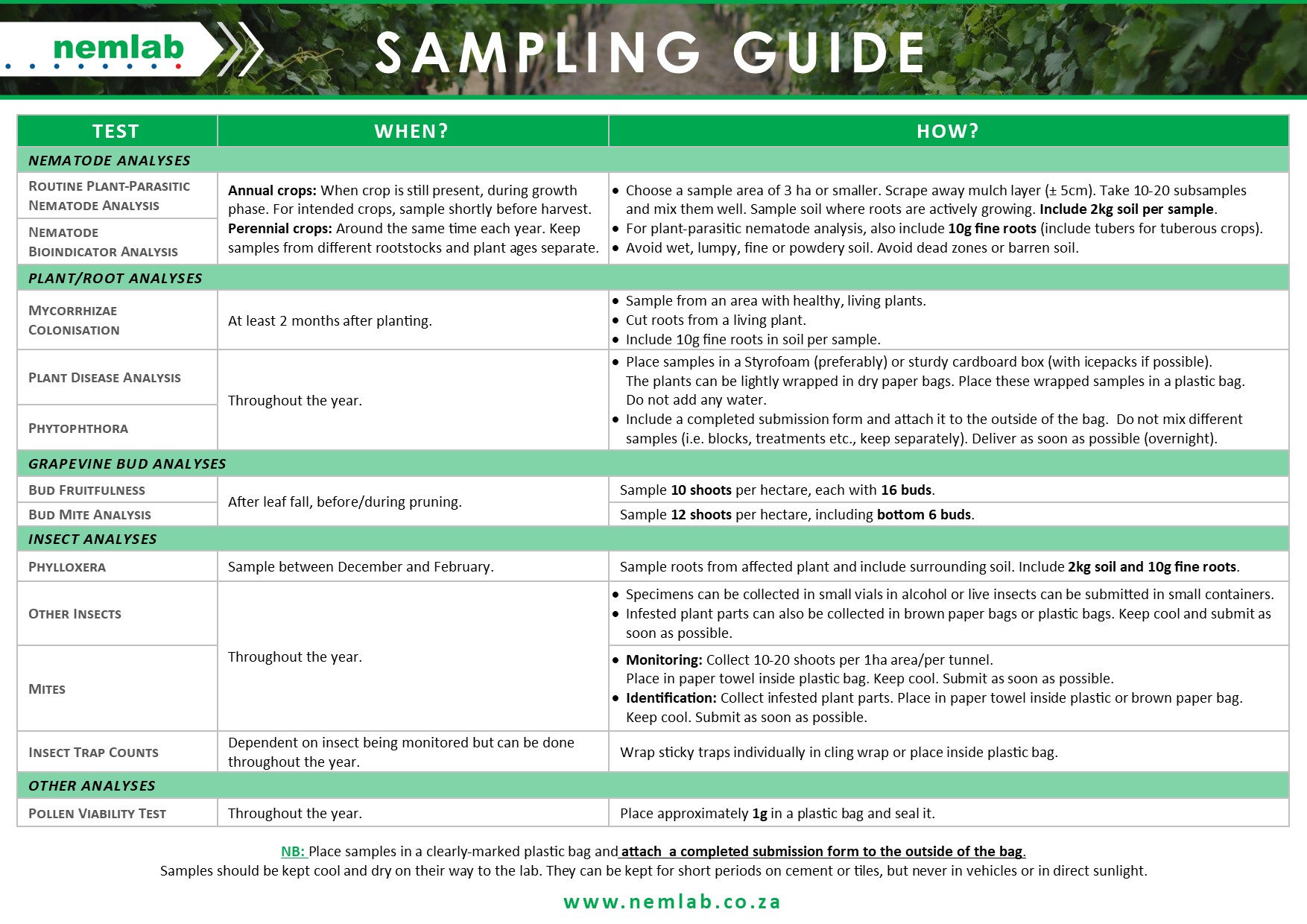
You can download the sampling guide here.
Samples can be taken throughout the year.
Avoid sampling wet soil with lumps as well as fine, dry or powdery soil. Samples should also not be taken in the vicinity of dead trees or in “dead” spots. Samples taken from barren or brackish soil will also give inaccurate results.
When sampling, a clear distinction is made between annual and perennial crops.
In the absence of roots, nematodes go into an egg stage and it is then difficult to determine the type of nematode present. Therefore, samples must at all times be taken when a crop is still present. Samples should also be taken during the growth phase and earlier rather than later.
For example, in the case of maize, the samples should be taken during flowering, but can be taken as late as just prior to harvest. If the soil is tested for an intended crop, the sample should be taken shortly before harvesting the previous crop.
Samples can be taken throughout the year. Counts are at their highest during the warmer summer months. Where counts are being compared on a year-to-year basis, the samples must be taken at the same time every year.
Samples from different rootstocks and plant ages must be separated. In the case of trees/vines being replanted, it is important that the samples are taken before the previous crop is removed.
The majority of tuberous crops are attacked by endoparasites that survive inside the tuber. It is therefore important that the tubers of these crops are included in the sample to be analysed.
Citrus and persimmons are both attacked by the citrus nematode. An accurate measure of the citrus nematode is to stain the roots making root material essential. For the staining technique at least 10 g of roots are required. The roots should be placed in enough soil to prevent them from drying out.
Samples must always be taken in the root zone, where new, active root growth takes place. The growth depth is usually between 10 – 50 cm but this will depend on various factors such as the individual soil type, crop planted, irrigation system and cultural practices. The top 5cm of soil should be removed and the sample should then be taken to a depth of approximately 50 cm.
The size of the sample area (orchard / block / land) must be 3 hectares or smaller. A representative sample must consist of 10 – 20 thoroughly mixed sub-samples.
It is important to include fine hair roots in the sample.
It is important that a sample must consist of at least 2 kg of soil and 10 g of FINE roots (click here)
The soil containing roots must be placed in a plastic bag and properly sealed. A fully completed submission form must be attached to the OUTSIDE of the plastic bag. (Download the FORM here)
Each bag must be clearly marked on the OUTSIDE with a label corresponding with the sample numbers on the form. Information should never be placed inside the plastic bag.
*Please note that incomplete information regarding crop, rootstock, plant age, etc., can delay the process in the laboratory and the availability of the results.
Samples can be sent either directly to one of our Nemlab branches or via Courier. Please contact us for more information.
The result of the analysis is given in a written report. The number and type of plant-parasites (damaging) and free-living (saprophytic) nematodes are discussed, and the report includes an interpretation of the nematode counts and a recommendation of the type of treatment required. The various nematicides registered for a particular crop are listed.
It takes approximately 10 days from the date on which the sample is received until the report is available. There are certain times of the year, e.g. February/March and September/October that the results may take longer.
You can download the pricelist here.